|
|
|
Categories
|
|
Information
|
|
Featured Product
|
|
|
 |
|
|
There are currently no product reviews.
 ;
Veramente completo, dettagliato e perfetto nella visione. Perfect, thanks!
 ;
Fully functional usable service manual. Considering the age of the manual and device quality was better than expected
;
Thank you very much, I've been very happy to find this manual on "Owner Manual". It's a perfect copy and it has been really useful for my work!
;
It took about 24-hours after my payment before I was able to get to the download. Apparently, payment processing is not 100% automated. That is no big deal, just be aware of that going in.
After I got to it, it was in good shape, easy to read, etc. Not some cheap FAX copy looking thing.
Also, this site was the cheapest I found. Another Plus!
;
Good price, very legible manual, exactly what I needed -- but had to wait a day to actually get the download of the manual. Would have preferred to download it immediately after payment rather than waiting for someone to "process" my order. I was surprised that I had to wait that long.
CS Series 60.4 CONTROLS AND SETUP
SETTING THE CROSSOVER(S) Determine your system plans and set the crossover mode switch accordingly. If your system design does not include a subwoofer with the CS60.4, set the crossover mode to FLAT and skip to �Setting Input Sensitivity.� Initially set the crossover frequency control midway. While listening to music, adjust the crossover for the least perceived distortion from the speakers, allowing them to reproduce as much bass as possible. Systems using a separate subwoofer set the crossover mode to HP (high pass) for your full-range speakers. Adjust the crossover frequency to limit bass and provide increased system volume with less distortion. For subwoofers, choose the highest frequency that removes vocal information from the sound of the subwoofer. If using the CS60.4 to drive a subwoofer(s), set the crossover mode to LP (low pass). SETTING INPUT SENSITIVITY 1. Initially turn the INPUT LEVEL control(s) to minimum (counter clockwise). 2. Reconnect the (�) negative lead to the vehicle�s battery. Apply power to the audio system and play a dynamic music track. 3. On the source unit, increase the volume control to 3/4 volume. Slowly increase the INPUT LEVEL control(s) toward three o�clock until you hear slight distortion in the music. Then reduce the INPUT LEVEL slightly until distortion is no longer heard. NOTE: After the source unit is on, blue LEDs (on the top panel) will light, indicating the amplifier is on. If not, check the wiring, especially the remote connection from the source unit. Also refer to �Troubleshooting� guide below.
TROUBLESHOOTING
SYMPTOM No audio (POWER LEDs are off) No audio (POWER LEDs are on) LIKELY CAUSE No voltage at BATT+ or REM terminals, connection ground or bad or no Amplifier is overheated SOLUTION Check voltages at amplifier terminals with VOM Make sure amplifier cooling is not blocked at mounting location; verify speaker-system impedance is within specified limits Check vehicle charging system SYMPTOM No audio (POWER LEDs flash) LIKELY CAUSE Voltage less than 9V on BATT+ connection DC voltage on amplifier output SOLUTION Check vehicle charging system Amplifier may need service; see enclosed warranty card for service information Check INPUT LEVEL setting; or check speaker wires for shorts or grounds Remove speaker leads one at a time to locate shorted speaker or wire, then repair Check speaker connections for proper polarity
Distorted audio
Voltage more than 16V or less than 8.5V on BATT+ connection
Distorted audio and POWER LEDs flash Music lacks �punch�
Input sensitivity is not set properly, or amplifier or source unit is defective Short circuit in speaker or wire
Speakers are not connected properly
Features, specifications and appearance are subject to change without notice.
4
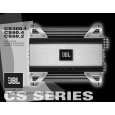 $4.99 CS60.4 JBL
Owner's Manual Complete owner's manual in digital format. The manual will be available for download as PDF file aft…
|
|
|
> |
|