|
|
|
Categories
|
|
Information
|
|
Featured Product
|
|
|
 |
|
|
There are currently no product reviews.
 ;
I am only search for 5 Minute, by it in 5 Minutes to and get ist in few ours! Best i found in the Internet and my Amplifer is repaired as well! Thank you
 ;
Readable text and good copy. Very much needed if you wish to do some repairs on this fine old unit.
;
Fint forløb med levering af manualen. Kvaliteten af skanningen betegnes som middel
;
I found the manual to be clear concise and complete. It was of immense assistance when removing the unit as the unit was over 22 years old and the wiring diagram was unobtainable from the manufacturer. The exploded drawings were clear as were the instructions and labels.
;
I will highly recommend this seller. They are honest, accurate, fast and responsible.
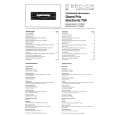
Abgleichvorschriften / Adjustment Procedures
MASQ RRCD 9100 PLL
Abgleichvorschriften
Tuner
Messgeräte: Mess-Sender, Oszilloskop, Digital-Voltmeter Abgleich 1. LW-Oszillator 2. MW-Oszillator 3. AM-ZF Vorbereitung Digital-Voltmeter an Messpunkt TP7. Digital-Voltmeter an Messpunkt TP7. Mess-Sender über Loopantenne einkoppeln. f = 450kHz; ohne Modulation Digital-Voltmeter an Messpunkt TP5. Mess-Sender über Loopantenne einkoppeln. ohne Modulation Digital-Voltmeter an Messpunkt TP5. Mess-Sender über Loopantenne einkoppeln. ohne Modulation Digital-Voltmeter an Messpunkt TP5. Digital-Voltmeter an Messpunkt TP7. Abgleichvorgang Bei 281kHz mit T502 auf 6,7V ± 0,2V abgleichen. Bei 1620kHz mit T501 auf 8,2V ± 0,2V abgleichen. Mit T509 auf Maximum abgleichen.
4. LW-Eingangskreis
Wechselweise mit LW COIL bei 153kHz und mit VC503 bei 261kHz auf Maximum abgleichen.
5. MW-Eingangskreis
Wechselweise mit MW COIL bei 558kHz und mit VC502 bei 1440kHz auf Maximum abgleichen.
6. FM-Oszillator
Bei 108,0MHz durch Verbiegen von L502 auf 7,0V ± 0,2V abgleichen. Wechselweise durch Verbiegen von L501 bei 88,0MHz und mit VC501 bei 106,0MHz auf NF-Maximum abgleichen.
7. FM-HF-Kreis
Mess-Sender an Antennen-Eingang; Ue ~ 25dBµV; fmod = 1kHz; Hub = 40kHz; Oszilloskop an CN501(-1) oder CN501(-3).
Cassette
Messgeräte: Oszilloskop, Frequenzzähler, Test-Cassette 3150Hz/10kHz (z.B. 448A) Abgleich 1. Bandgeschwindigkeit Vorbereitung Frequenzzähler an Lautsprecher. Test-Cassette (3150Hz-Teil) abspielen. Abgleichvorgang Mit Motorpoti auf 3150Hz ± 10Hz abgleichen.
Motorpoti
2. Azimut
Oszilloskop an Lautsprecher. Test-Cassette (10kHz-Teil) abspielen.
Mit Kopfschraube A auf maximalen und gleichen Pegel in beiden Kanälen einstellen.
A
3. Löschoszillator
Frequenzzähler an CN401(-1) oder CN401(-3). Aufnahme starten.
Mit L401 auf 62kHz ± 300Hz abgleichen.
Abgleichlageplan Tuner
Abgleichlageplan Cassette
2-1
GRUNDIG Service
|
|
|
> |
|