|
|
|
Categories
|
|
Information
|
|
Featured Product
|
|
|
 |
|
|
There are currently no product reviews.
 ;
I found this rare manual, in french ! The brand of my washing machine is not famous but this site had the manual, that is perfect.
;
The manual was everything that I wanted. Clearly printed and delivered in very quick time. Would certainly use again if I needed a manual in the future
;
I received the manual in correct time. It was a perfect help for me.
;
excellent quality, contains circuits and scan quality, 226 pages
 ;
Great price for the manual and easy to locate on the site and download. I would buy again.
Note
You cannot record from a microphone when the recorder is attached to the station.
Note
Note that REC LEVEL is effective even during recording; adjusting it will change recording level.
To adjust the recording level manually
1
2 3
4 Tip
While holding down P, press and hold REC to the right for more than 2 seconds. The recorder stands by for recording. Play the source. Observe the level meter in the display and adjust the recording level by pressing + (+) or = (�) . Set the level so that the meter shows 4 bars at average input level. Press P again to start recording.
Setting the clock to stamp the recorded time
See the illustrations in the Japanese text (page 22). To stamp the date and time on the MD when you record, you need to set the clock. You can set the clock either from the detached recorder, or from the station when the recorder is attached. 1 Press CLOCK SET button at the rear of the station with a pointed object. The digits of the year flash. Enter the current year by pressing � or µ. To change the digits rapidly, keep pressing � or µ. Press m to enter. The digit of the month flashes. Repeat steps 2 and 3 to enter the current month, date, hour, and minute. After you press TITLE/ENTER to set the minutes, the clock starts operating.
The recorder switches back to automatic control when you press p to stop recording.
2
Note
Adjust recording level while the recorder is in standby mode. You cannnot adjust it while recording.
3 4
Recording through analog input (Analog recording)
See the illustrations in the Japanese text (page 20). When recording from a radio or a record, connect analogically (page 75) and record as follows. Be sure to adjust recording level manually. 1 2 3 Insert a recordable MD. Set INPUT to ANALOG. Select the point to start recording. If you want to record form the end of the previous recording, press END SEARCH. While holding down P, press and slide REC to the right. Play the source. Observe the level meter in the display and adjust the recording level with REC LEVEL. Set the level to around 12 (-12dB) at average input level. Press P again to start recording.
If you made a mistake while setting the clock
Press p button and repeat the steps above. Press m to locate necessary digits to be changed.
Operating Instructions
To set the clock on the recorder
The procedure is the same as in setting the clock on the station. Press CLOCK SET at the bottom of the recorder so that the digit of the year flashes. Change the number with = or +, and enter with (. When you press ( to enter the minute, the clock starts operating. If you attach the recorder to the station after you have set the clock on the recorder, the clock on the station will be synchronized automatically.
4 5 6
7
69
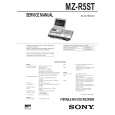 $4.99 MZR5ST SONY
Service Manual Complete service manual in digital format (PDF File). Service manuals usually contains circuit diagr…
|
|
|
> |
|